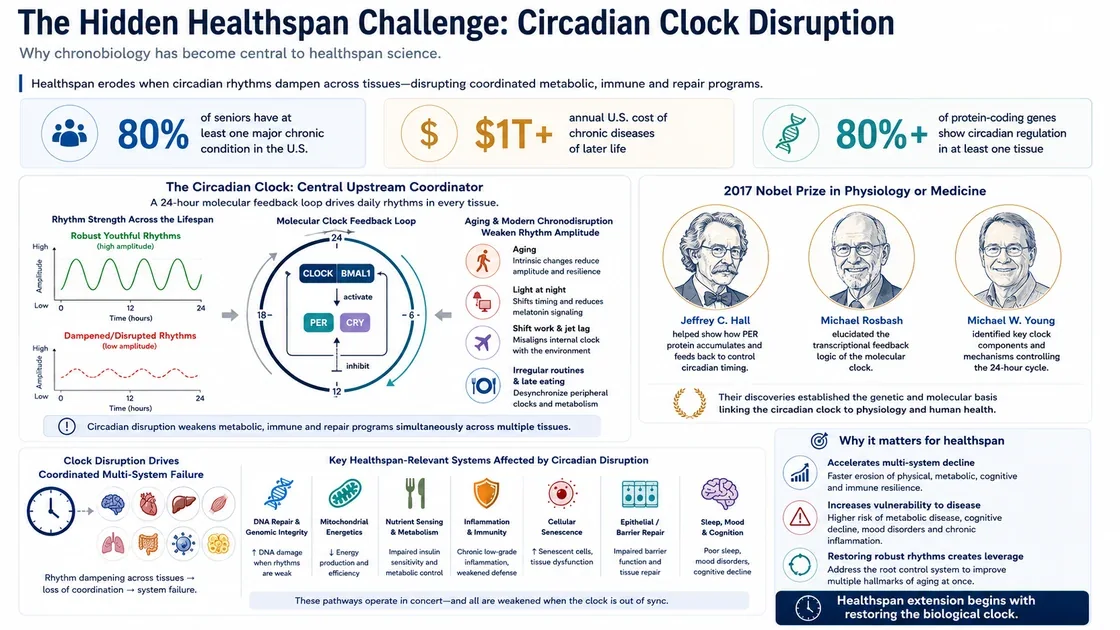
Biology is not constant from one hour to the next. Sleep and alertness are the most visible examples, but timing also shapes metabolism, hormone signaling, immune activity, barrier function, repair and cellular energy.
There is no single body clock
A light-responsive clock in the brain helps organize daily timing, but local oscillators exist throughout the body. Liver, muscle, gut, skin and other tissues respond to both central signals and local cues such as meals, activity and temperature.
Coordination is the upstream idea
When clocks remain strong and appropriately coordinated, daily programs can occur in a more organized sequence. With aging, irregular schedules, night light, shift work or other disruption, rhythms may become weaker, shifted or less resilient.
A systems-level relationship creates a research opportunity. It does not prove that one intervention reverses aging or every downstream pathway.
Amplitude and phase answer different questions
Phase describes when a recurring event peaks. Amplitude describes the strength of the oscillation. A rhythm can shift without weakening, or weaken without a major phase change. DeepSense’s platform thesis is especially interested in amplitude, but measurement must keep these properties separate.
Why repeated measurement matters
A single blood value, wearable score or biopsy cannot usually characterize a rhythm. Appropriate studies need repeated measures, time-standardized sampling or validated longitudinal proxies. Confounding from sleep, meals, light, activity and medication should be measured rather than ignored.
From systems biology to member education
The membership program uses biological time as an organizing frame. Product-level claims remain narrower: tied to the final format, dose, use, market and evidence dossier. This distinction allows the story to remain ambitious without becoming irresponsible.
Context and source notes
For deeper context, review the current DeepSense pages on chronobiology and circadian rhythms and healthy aging. This article is educational and is not medical advice.