01
Define the mechanism
Phase, amplitude, duration, synchrony, local activation or time-dependent exposure.
Chronobiotics
Chronobiotics are substances or interventions studied for effects on biological timing. The category can include phase alignment, amplitude enhancement, time-dependent exposure and tissue-specific timing.
A disciplined definition
The intervention should state what timing property is expected to change and use a design capable of detecting that change.
Phase, amplitude, duration, synchrony, local activation or time-dependent exposure.
Use repeated molecular, physiological, behavioral or validated digital measures appropriate to the hypothesis.
Show why the timing change matters to the intended application and population.
Four chronobiotic territories
DeepSense separates these territories so a broad category story does not blur the outcome actually tested.
Moving the timing of a rhythm earlier or later relative to external or internal time.
Investigating whether rhythmic expression becomes stronger or more robust without assuming a phase change.
Testing whether an established active produces different effects depending on when it is delivered.
Considering local clock biology, delivery pathway and target-tissue context.
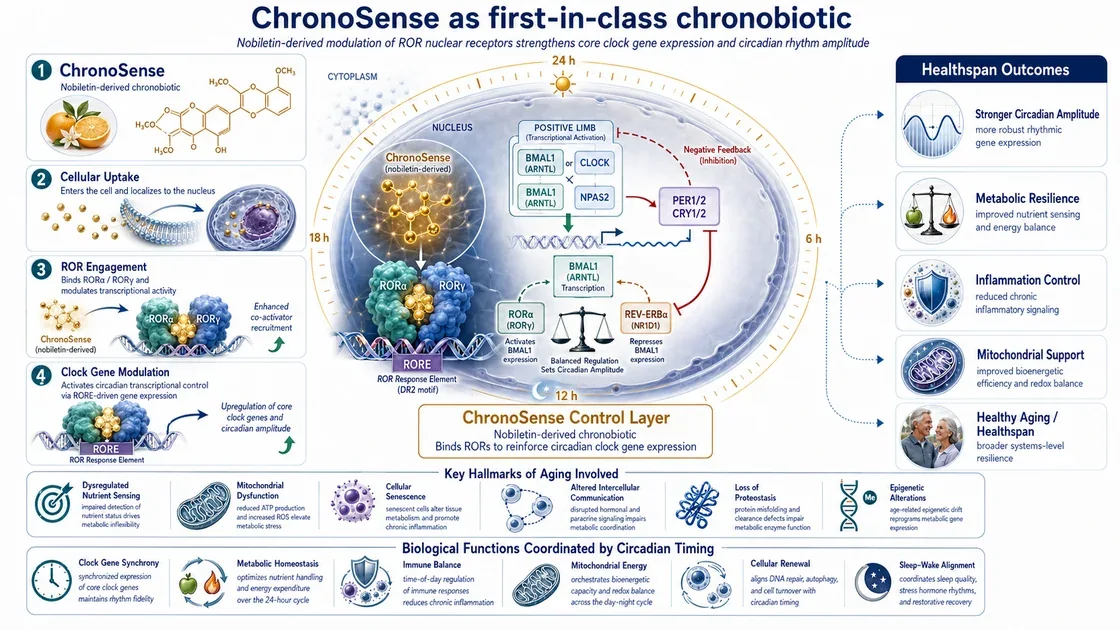
ChronoSense mechanism hypothesis
This DeepSense systems visual describes the molecular rationale for a nobiletin-derived chronobiotic. It is mechanistic context, not a guarantee of the healthspan outcomes shown.
Category glossary
Clear language makes the science more credible and the member experience easier to understand.
Approximately 24-hour biological timing, generated by endogenous systems and influenced by external cues.
Using timing as part of an intervention strategy; exact meaning depends on the medical or wellness context.
A person’s tendency toward earlier or later timing. It is not a complete diagnosis or a substitute for rhythm measurement.
Synchronization of an internal rhythm to a recurring external cue.
Coordination among rhythms within or across tissues and systems.
The ability of a rhythm or system to maintain or recover organization after disruption.
The claim rule
ChronoSense can lead a bold chronobiology category while each ingestible or topical claim remains within the evidence dossier and regulatory context for that format.
| Layer | Preferred territory | Avoid |
|---|---|---|
| Thought leadership | Chronobiology is healthspan science. Aging can include a loss of rhythmic coordination. | Disease-treatment or age-reversal promises. |
| Platform narrative | Designed around support for healthy circadian rhythms and rhythm strength. | Unqualified claims that the platform cures or prevents disease. |
| Member product | Format-specific structure/function or cosmetic language backed by substantiation. | Assuming the category story proves every product benefit. |

Your journey starts here
See how ChronoSense connects a nobiletin-derived active, delivery pathways, day-and-night expressions and an annual membership ritual.