Metabolic health
Daily timing intersects with nutrient sensing, glucose handling and energy use. Member content focuses on rhythm-supportive practices and appropriately positioned products.
The Science of Healthspan
Chronobiology studies the rhythms that coordinate physiology and behavior. The membership site explains enough science to make the program intelligible—then hands deeper evidence back to the corporate DeepSense evidence environment.
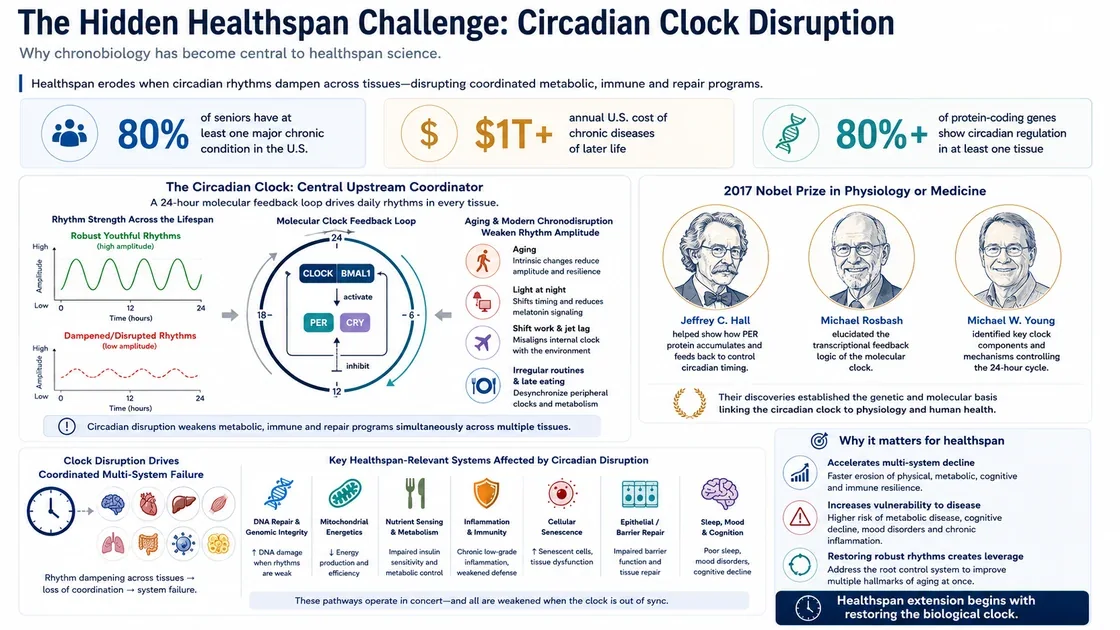
A 24-hour coordination system
Central and peripheral clocks interact with light, food, activity, temperature and hormones. The result is a network of rhythms whose timing, strength and coordination can matter independently.
The circadian system includes a central light-responsive coordinator and local oscillators in tissues such as liver, muscle, gut and skin.
That architecture helps explain why healthspan questions often cut across multiple domains at once. It does not prove that one intervention changes every downstream system.
Explore Biological TimeSix healthspan domains
DeepSense uses a systems frame while keeping every product claim specific to its evidence, format, population and market.
Daily timing intersects with nutrient sensing, glucose handling and energy use. Member content focuses on rhythm-supportive practices and appropriately positioned products.
Feeding time, barrier biology and microbial activity follow daily patterns. The program explores this relationship without replacing clinical care.
Alertness, memory and restoration are embedded in biological time. Guidance emphasizes coordinated routines and evidence-aware support.
Sleep is one expression of a wider timing system. The program addresses alignment, recovery and resilience without reducing chronobiology to sleep alone.
Immune signaling is temporally organized. Member education distinguishes established biology from product-specific evidence.
Cellular energy and redox processes vary across the day. This pathway is presented as a systems-level area of investigation and support.
Choose a learning path
Begin with the human idea of biological time, then explore the category, the ChronoSense platform and the rules used to judge evidence.
Central and peripheral clocks, amplitude, phase and everyday timing inputs.
Start here →What the category means—and why taking something at night does not automatically make it a chronobiotic.
Define the category →A nobiletin-derived scaffold, proprietary delivery and oral/topical expressions built around timing.
Meet the platform →How established biology, mechanism, preclinical work, human proof of concept and investigation remain separate.
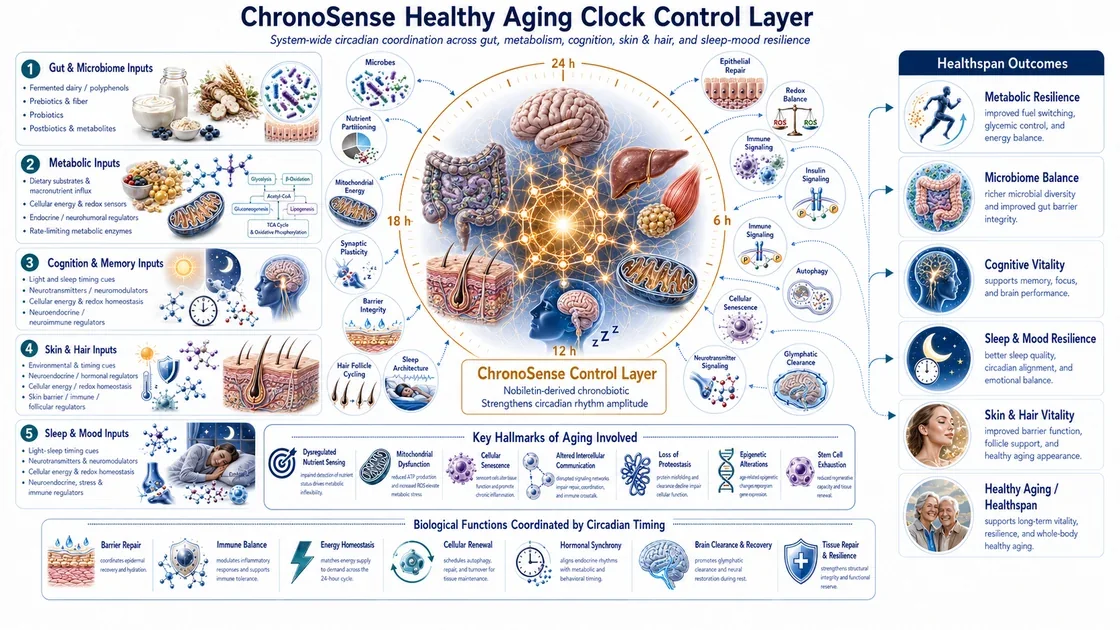
Review the standards →DeepSense systems visual
This illustration is adapted from the current DeepSense site and is presented as a systems map, not as a promise that every listed outcome has been demonstrated in members.
Evidence labels
Every meaningful scientific statement should tell the reader what kind of evidence supports it and where the limits sit.
Widely supported circadian or physiological principle. This is context—not proof that a particular product produces a benefit.
Laboratory or molecular rationale relevant to ChronoSense, nobiletin-derived scaffolds or biological timing.
Cellular or animal evidence, clearly separated from human outcomes.
Human findings presented with the study design, population, endpoint and limitations visible.
A future capability, application, study or hypothesis. It is never presented as an established benefit.

Your journey starts here
After exploring the science, compare the three membership tiers and the level of product expression, education and support each provides.